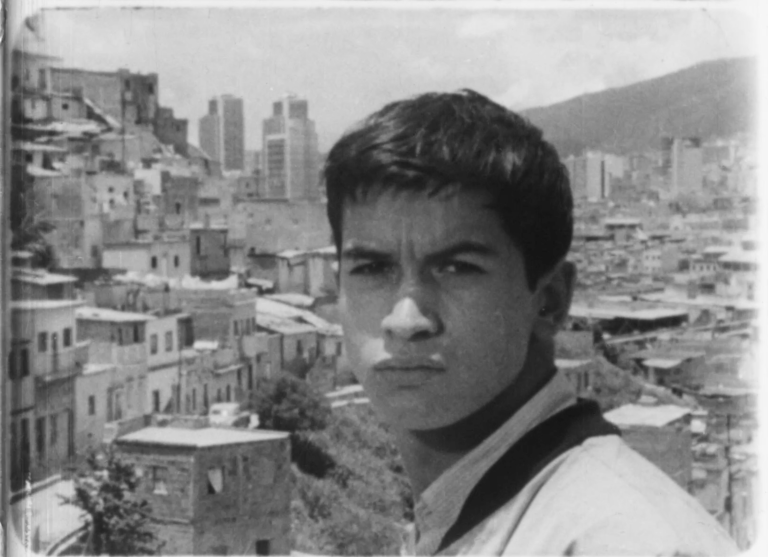
Pozo muerto (1967)
Pozo muerto (1967)
Carlos Rebolledo | 35mm | Digital Restoration 2024–2026
VHS Version – Transfered to DVD
This video shows the original source material before any restoration or intervention.
Original Scanned Material 4K
This video shows the original source material before any restoration or intervention.
After Restoration with Diamant
This video shows the original source material before any restoration or intervention.
Latest Restoration Version (Work in progress)
This video shows the original source material before any restoration or intervention.
The Film
Pozo muerto (1967) is one of the foundational works of Venezuelan political documentary cinema and one of the earliest Venezuelan films produced within the logic of what Fernando Solanas and Octavio Getino would theorize, two years later, as Third Cinema. Directed by Carlos Rebolledo — a graduate of the Institut des Hautes Études Cinématographiques in Paris and one of Venezuela’s most rigorous film intellectuals — the film presents three testimonial accounts delivered in an autobiographical, first-person register by a barber, a journalist, and a fisherman from the oil towns of Cabimas and Lagunillas, in the Lake Maracaibo basin.
The film was produced under the auspices of El Techo de la Ballena (1961–1969), the radical Venezuelan interdisciplinary arts collective that brought together poets, painters, filmmakers, and sculptors in a shared project of politically committed cultural production. Pozo muerto was screened at the 1st Festival de Cine de Viña del Mar, Chile, in 1967, the foundational event at which the term New Latin American Cinema was consolidated as a political and aesthetic movement. Rebolledo made personal contact there with Fernando Solanas, Fernando Birri, Glauber Rocha, and Maurice Capovilla.
One of the film’s opening intertitles states with deliberate irony: “Sixty years have passed since the exploitation of oil wealth began. The three stories we present here are intended to bear witness to that wealth.” The gap between the official discourse of national prosperity and the lived experience of those in the oil zones — poverty, abandonment, the destruction of local fishing economies — is the film’s political substance. As Gonzalo Selgas has noted, Pozo muerto is “one of the few cinematic accounts that, at that particular moment in history, exposes the consequences of foreign oil companies’ operations in the country.” That substance has not aged.
Why This Restoration
Venezuela presents what this restoration project has called a politically ironic archival emergency: a left-wing political cinema deteriorating under a nominally left-wing government that has failed to invest oil wealth in cultural preservation. The entire Venezuelan film heritage is at risk. Pozo muerto — a film whose subject is precisely the human cost of oil extraction — was itself deteriorating inside the archive of the country whose oil wealth it documents.
To restore this film is not a neutral archival act. It is, as Giovanna Fossati argues of archival practice more broadly, an act of actively shaping which versions of the past remain accessible to future generations. The political argument of Pozo muerto — about Venezuelan neocolonialism, foreign extraction, and the abandonment of those who live in the oil zones — connects directly to the present political and economic crisis of Venezuela. Bringing this film back into circulation is a continuation of the epistemic and political project that generated it.
The Materials
Pozo muerto was digitized from three 35mm reels held at the Fundación Cinemateca Nacional de Venezuela, using a Blackmagic Cintel Scanner G2 operated by CINESA (Cinematografía Especializada, S.A.) — the only professional film scanning service provider in Venezuela. The scan produced CRI (Cintel Raw Image) sequences at 4K resolution (4096×3000 pixels) and three separate WAV files containing the digitized optical audio.
The preliminary inspection of the scanned materials revealed a significant and historically informative asymmetry. Reel 1 — a positive ORWO print — showed visible image instability and a high density of surface damage: scratches, shrinkage, excessive flicker, dust accumulation, and staining consistent with repeated projection and difficult storage conditions. This was the copy people watched. Reels 2 and 3 — a Kodak Eastman panchromatic fine grain negative and a Ferrania panchromatic negative respectively — were in markedly better condition, presenting only minor stability fluctuations, light surface dust, and natural photochemical flicker, with no signs of hydrolysis. These appear to be the original camera negatives used to make the final cut, and they survived in relative integrity because they were never projected.
The optical audio track was present on the positive print but the three negative sound reels were used for the final restoration, being in better condition and preserving the consistent sonic character of the original materials throughout the film’s full duration.
Pozo muerto was processed in Cuba, circa 1967.
The Restoration Process
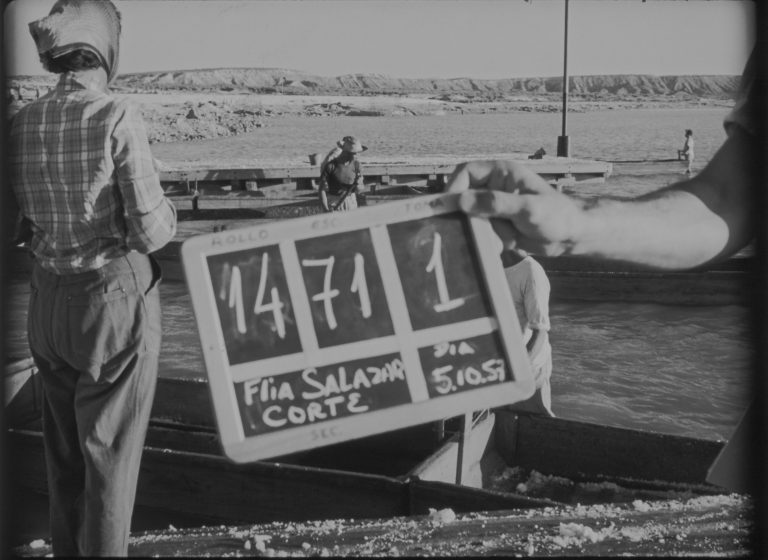
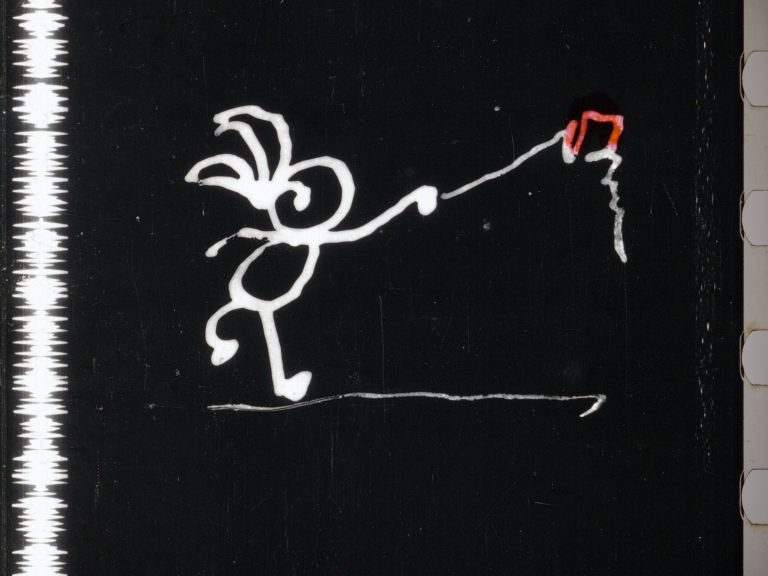
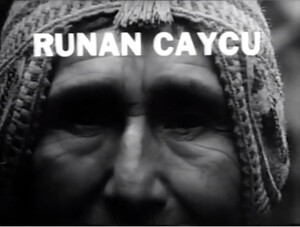
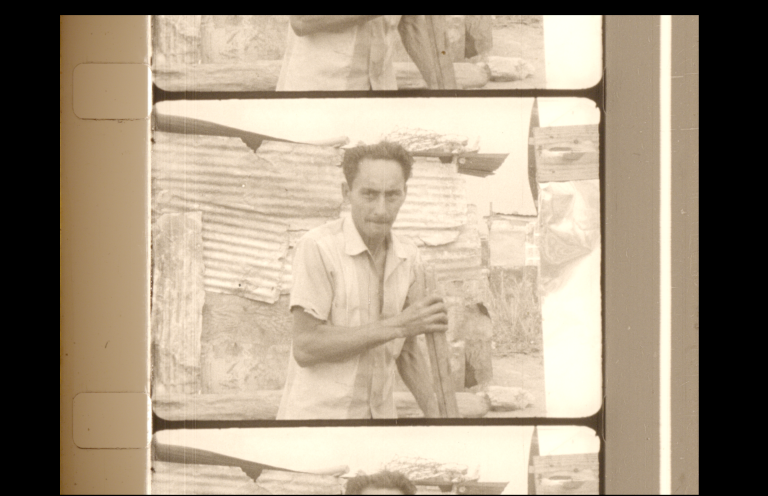
→ Direct scan — unrestored material → After Diamant restoration — pre-color grading → Final restored version — color grading and audio post → Previous VHS/DVD reference version
The restoration pipeline followed a consistent priority hierarchy: stabilization → deflicker → dust and scratch removal → stain and tear correction → audio restoration → color grading. All interventions were performed using the Diamant Film Restoration Suite integrated within DaVinci Resolve Studio, working on DPX sequences transcoded from the original CRI files at 12-bit depth — the FIAF-recommended uncompressed archival standard.
A selective workflow was adopted for Reels 2 and 3: given that converting the full 35mm negative material to DPX would bring the per-frame file weight from 17MB to approximately 51MB — making the process storage-prohibitive — only the scenes requiring significant intervention were transcoded to DPX for processing in Diamant. The remaining material, in relative good condition, was retained in native CRI format for direct color grading in DaVinci Resolve Studio. Reel 1, given the extent of its damage, was transcoded in full. This decision is documented here so that future restorers may make a different choice if their resources permit.
In accordance with Julia Wallmüller’s principle of characteristic look — the defining material properties of grain structure, contrast, sharpness, and luminance that constitute a film’s aesthetic identity — grain structure was preserved throughout. No denoising, artificial sharpening, or frame interpolation was applied. The scratches, natural flicker, and photochemical traces of Reel 1 were treated with restraint, following what Wallmüller describes as an approach analogous to the tratteggio technique in painting restoration: interventions that reduce visible damage without erasing it entirely, leaving the trace of the film’s individual history intact.
Color grading was guided by the zone system framework developed by Ansel Adams — a photographic method for managing tonal values across the full range from pure black to pure white — applied through DaVinci Resolve’s waveform and histogram scopes to correct the tonal compression introduced by photochemical deterioration, without imposing a standard of artificial perfection.
Audio restoration was performed using iZotope RX for noise reduction, click removal, and tape hiss attenuation. Final mixing and synchronization were completed in Pro Tools. The testimonial voices of the barber, the journalist, and the fisherman — the political substance of the film — were treated as a priority equal to image quality. They must remain audible.
The result is what this project calls an imperfect restoration: honest about its conditions, rigorous within its constraints, and committed above all to access. This is not a betrayal of Third Cinema’s politics. It is, as Laura Errazu and Lorena Pedregal have argued of Third Cinema itself, “research from below” — guerrilla restoration as the only possible alternative, and enough.
Deliverables
The restoration produced the following archival and access formats:
- DPX sequence at 4K / 12-bit depth — uncompressed preservation master
- DCP (Digital Cinema Package) — for theatrical and festival exhibition
- ProRes 422 HQ at 1080p — for educational and institutional distribution
- H.264 — for online access and low-bandwidth preview
- 24-bit / 48kHz WAV — restored and mixed audio master
- CRI files — original scanned material, retained for future restorers
- LTO tape copies — long-term offline preservation
Total data volume for Pozo muerto (31 min.): approximately 3.16 TB.
Acknowledgements
This restoration would not have been possible without the institutional support and personal generosity of the Fundación Cinemateca Nacional de Venezuela, who granted access to the collection and its equipment at a moment of profound institutional difficulty, and of CINESA (Cinematografía Especializada, S.A.), who provided the scanning service. Special thanks are due to Francisco Ramírez, Senior Archivist at the Fundación Cinemateca Nacional, whose knowledge of the collection and hands-on collaboration in the prospection and preparation of the film elements for digitization was indispensable at every stage of the process.
Sincere thanks to Ángeles Chantada, widow of Carlos Rebolledo, for her trust, her generosity, and for signing the license of use that made this restoration legally and institutionally possible. Her support was an act of faith in the value of this work.
This restoration was funded by the Universidade Lusófona Film Memory Programme and carried out as part of the Erasmus Mundus Joint Master in Film Memory.